laReverdie
Claudia Caffagni, voz e sinos voice and bells
Caterina Chiarcos, voz voice
Elisabetta di Mircovich, voz, sanfona e viola voice, hurdy-gurdy and viol
Daniela Beltraminelli, voz voice
Livia Caffagni, flautas e voz flute and voice
Filipa Taipina, voz voice
Esperanza Filgueiras, voz e saltério voice and psaltery
Maria Bayley, órgão organ
Hildegard Von Bingen – Uma abadessa compositora
Hildegard von Bingen nasceu em Bermersheim, na Alemanha, em 1098 no seio de uma família nobre ao serviço dos condes de Sponheim. Foi a décima filha de Hildebert e Mechthild e por tal foi entregue à igreja como dízima, uma tradição daquela época. Aos oito anos de idade, Hildegard entra no eremitério do mosteiro de Disibodenberg dirigido por Jutta, filha do conde de Sponheim, ficando aos seus cuidados. Jutta introduziu-a na forma de vida dos beneditinos e foi a responsável pela sua formação.
Hildegard von Bingen foi aristocrata, abadessa, compositora e poetisa. Visionária, mística e naturalista. Escritora e dramaturga, hagiógrafa e linguista. Doutora da igreja, santa e autora de uma imensa e importante obra literária, teológica e científica.
Foi correspondente de figuras de relevância da época, tais como imperadores, reis, bispos e abades tendo conquistado a protecção e a amizade de Frederico II e Bernardo de Claraval. Hildegard foi também reconhecida pelo Papa Eugénio III como visionária.
Considerada capaz de responder a temáticas religiosas e políticas e a questões relativas à natureza e ao comportamento humano, Hildegard foi autorizada a divulgar um complexo quadro visionário e a pregar em público na sua região e em diversas cidades, tendo viajado por todo o território germânico e Francês.
A sua prodigiosa inteligência e a qualidade do seu trabalho consolidaram o sucesso alcançado e tornaram possível que na história da Igreja, numa época marcadamente de produção anónima, tivesse conseguido alcançar um notório e destacado reconhecimento.
A obra musical de Hildegard von Bingen é caracterizada pelo uso de grandes fórmulas melismáticas que jogam em alternância com um tipo de composição mais neumático e silábico. Hildegard recorre frequentemente à variação constante de séries de fórmulas melódicas às quais vai introduzindo pequenas variantes que proporcionam ao ouvinte a sensação de novidade contínua. Hildegard consegue enfatizar e dramatizar os seus textos e a sua poesia jogando com as diferenças estruturais dos modos de Ré e Mi. A extensão vocal da sua obra é muito alargada e nunca vista, que seja do nosso conhecimento, em nenhum tipo de música escrita até à época, conferindo-lhe um certo virtuosismo vocal.
Hildegard von Bingen foi uma representante da cultura beneditina e fez parte de uma série de mulheres influentes que viveram ao longo da Idade Média.
Neste concerto serão interpretadas seis peças desta compositora, precedidas por improvisações ao Órgão baseadas nessas melodias. Esta interpretação é feita a partir de fontes primárias, codex Dendermonde e códex Riesenberg, os dois manuscritos que contêm toda a obra musical de Hildegard von Bingen.
Filipa Taipina
Hildegard von Bingen – An abbess and composer
Hildegard von Bingen was born in Bermersheim, Germany, in 1098, into a noble family serving the counts of Sponheim. She was the tenth child of Hildebert and Mechthild and, as such, she was given to the church as a tithe, a tradition of that time. At eight years old, Hildegard entered the hermitage of the Disibodenberg Monastery, led by Jutta, the daughter of the Count of Sponheim, who became her guardian. Jutta introduced her to the Benedictine way of life and was responsible for her education.
Hildegard von Bingen was an aristocrat, abbess, composer, and poet. Visionary, mystic, and naturalist. Writer and playwright, hagiographer, and linguist. Doctor of the Church, saint, and author of a vast and significant literary, theological, and scientific body of work.
She corresponded with prominent figures of her era, such as emperors, kings, bishops, and abbots, having earned the protection and friendship of Frederick II and Bernard of Clairvaux. Hildegard was also recognised as a visionary by Pope Eugene III.
Regarded as capable of addressing religious and political themes as well as questions concerning nature and human behavior, Hildegard was authorised to share a complex visionary framework and to preach publicly in her region as well as in various cities, having traveled throughout German and French territories.
Her prodigious intelligence and the quality of her work consolidated her success and made it possible for her to achieve notable and distinguished recognition in the history of the Church, at a time largely marked by anonymous production.
The musical works of Hildegard von Bingen are characterised by the use of long melismatic formulas, alternating with a more neumatic and syllabic style of composition. Hildegard frequently used constant variation in series of melodic formulas, introducing small variants that provide the listener with a continual sense of novelty. Hildegard managed to emphasize and dramatize her texts and poetry by playing with the structural differences of the Protus and Deuterus modes. The vocal range of her works is very wide and, as far as we know, unprecedented in any type of written music up to that time, giving her pieces a certain vocal virtuosity.
Hildegard von Bingen was a representative of Benedictine culture and was part of a series of influential women who lived throughout the Middle Ages. In this concert, six pieces by this composer will be performed, each preceded by improvisations on the organ based on those melodies. This interpretation is based on primary sources, Dendermonde Codex and Riesenberg Codex, the two manuscripts that contain the entire musical output of Hildegard von Bingen.
Filipa Taipina
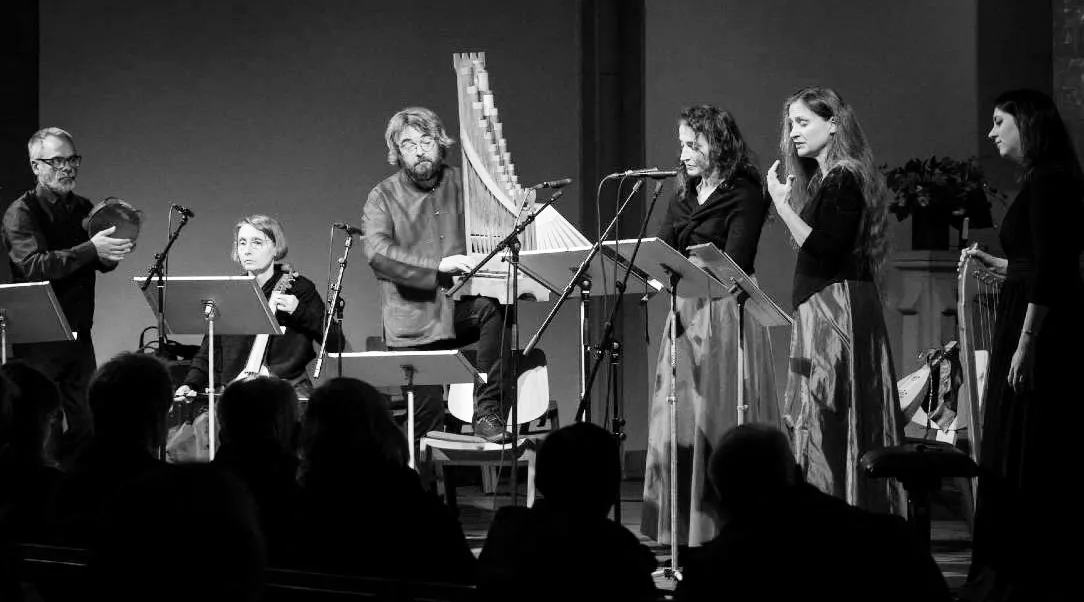
Ensemble laReverdie
Desde o início, e para dar vida ao vasto e variado repertório medieval, os membros do ensemble laReverdie consideraram fundamental cantar e tocar vários instrumentos. Dessa forma, desenvolveram uma linguagem e uma sonoridade comuns que os tornam inconfundíveis, quer pela mistura das suas vozes como dos seus instrumentos.
Ao longo de 40 anos de pesquisa, laReverdie interpretou música desde o canto monódico litúrgico até aos primeiros exemplos de polifonia, da Ars nova italiana e francesa até à complexa polifonia franco-flamenga do século XV. Aprofundou também a prática da improvisação que por vezes usou em diálogo com instrumentos de outras culturas.
O grupo é regularmente convidado a apresentar-se em Festivais e Temporadas de Concertos em Itália, Suíça, Áustria, Alemanha, França, Inglaterra, Espanha, Portugal, Bélgica, Holanda, Polónia, Eslovénia, Suécia, Hungria e México.
Gravaram vinte CDs, para a etiqueta ARCANA com os quais receberam vários prémios da imprensa europeia, como por exemplo o Diapason d’Or do ano 1993 que lançou a carreira do ensemble.
Nos últimos anos, algumas peças gravadas por laReverdie foram escolhidas para bandas sonoras de filmes e em 2021 o ensemble foi convidado a gravar uma música original para o filme Across the River and Into the Trees, realizado por Paola Ortiz.
O ensemble tem colaborado, em projectos especiais, com Franco Battiato, Moni Ovadia, Carlos Nuñez, Teatro del Vento, Gerard Depardieu, Mimmo Cuticchio, David Riondino e Christophe Deslignes.
Since the very beginning, in order to bringing alive the reach and varied medieval repertory, the members of laReverdie considered crucial to both sing and play several instruments. With this purpose, they have developed a common language and sound that rend them unmistakable both for the mixture of their voices as well as of their instruments.
Along the over 40 years of research, laReverdie has ranged from the liturgical chant to the first examples of polyphony, from the Italian and French Ars nova to the complex Franco-Flemish polyphony of Quattrocento, deepening also the practice of improvisation, sometimes in dialog with instruments of other cultures. The group is regularly invited to perform in Festivals and Concert Seasons in Italy, Switzerland, Austria, Germany, France, England, Spain, Portugal, Belgium, Netherlands, Poland, Slovenia, Sweden, Hungary, Mexico.
They have recorded twenty Cds, for ARCANA/Outhere Music which have received various awards from the European press, such as the Diapason d’Or de l’Année 1993 which has launched the ensemble’s career.
In recent years, songs recorded by laReverdie have been chosen for some soundtracks and in 2021 the ensemble was invited to record an original song for the film Across the River and Into the Trees, directed by Paola Ortiz.
The ensemble has collaborated, in special projects, with Franco Battiato, Moni Ovadia, Carlos Nuñez, Teatro del Vento, Gerard Depardieu, Mimmo Cuticchio, David Riondino and Christophe Deslignes.
Hildegard von Bingen (1098-1179)
Antífona Antiphon
Hodie aperuit nobis clausa porta
Symphonia virginum
O dulcissime amator
Antífona Antiphon
O frondens virga / Psalmus 44
Antífona Antiphon
Cum erubuerint infelices
Antífona Antiphon
Nunc gaudeant
Sequência Sequence
O virga ac diadema
Todas as peças serão precedidas de improvisações ao órgão
All the pieces are preceded by organ improvisations